
Thinking about company formation? Turkey is one of the most open countries in the region for foreign founders. You can own 100% of a Turkish company. You do not need a local partner. And the whole setup takes days, not months. This company formation Turkey guide covers what foreign founders need in 2026: company types, minimum capital, costs, the registration steps, work permits and taxes.
Can a Foreigner Own a Business in Turkey?
Yes — fully. The Foreign Direct Investment Law (Law No. 4875) gives foreign investors national treatment. Unless a specific law says otherwise, you invest under the same rules as Turkish citizens. In practice, this means four things:
- 100% foreign ownership is allowed. No Turkish partner, sponsor or nominee is needed.
- No prior approval is required for ordinary sectors.
- Both foreign individuals and foreign companies can hold shares.
- Profits and sale proceeds can be sent abroad through banks, after tax.
A few regulated fields — banking, insurance, aviation, broadcasting — have special licence rules. For trade, services, software, tourism and manufacturing, the road is open. The state investment office (Invest in Türkiye) confirms the same principle.
Types of Companies in Turkey
The Turkish Commercial Code (Law No. 6102) lists several company forms. Three of them matter for foreign founders.
Limited Liability Company (Ltd. Şti.) — the Turkish LLC
This is the workhorse of foreign investment in Turkey. The minimum capital is TRY 50,000. One shareholder is enough — a person or a company, Turkish or foreign. The company is run by one or more directors (müdür), and at least one director must be a shareholder. You do not have to pay the capital at incorporation. It can be paid within 24 months of registration.
One warning that most guides skip: liability is limited, but not for everything. If the company leaves public debts unpaid — taxes and social security — shareholders can be pursued for them, in proportion to their shares. Foreign founders should know this before they lend their name to a company.
Joint Stock Company (A.Ş.)
The A.Ş. is the corporation form. It suits larger ventures, holding structures and companies that plan to raise money. The minimum capital is TRY 250,000 — or TRY 500,000 under the registered capital system. These figures come from Presidential Decision No. 7887 and apply since 1 January 2024. At least 25% of the cash capital must be paid before registration. The rest follows within 24 months.
One shareholder is enough. A board of directors manages the company. Shares can be transferred without a notary, and share sales enjoy certain tax advantages. That is why growth-minded founders often pick the A.Ş. despite the higher capital.
Sole Proprietorship (Şahıs İşletmesi)
This is the simplest and cheapest option. There is no minimum capital. Registration is fast. Profits are taxed as personal income, not corporate income. The trade-off is harsh, though: you are personally liable for all business debts, without limit.
For foreigners there is an extra hurdle. Running a sole proprietorship means working independently in Turkey. That requires an independent work permit under Article 13 of the International Labour Force Law (Law No. 6735) — and these permits are granted selectively. There is a helpful exception. Under Article 16/1-g of the same law, a foreigner who is married to a Turkish citizen and lives with their spouse in Turkey can receive an exceptional work permit, outside the ordinary criteria. In practice, this is the realistic path for a foreign spouse who wants to be self-employed. One caveat: the privilege rests on a genuine marriage. Under Article 56/k of the implementing regulation, the permit is cancelled if officials report the marriage as a sham.
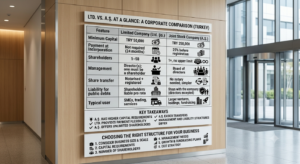
Ltd or A.Ş. at a Glance
| Limited (Ltd. Şti.) | Joint Stock (A.Ş.) | |
|---|---|---|
| Minimum capital | TRY 50,000 | TRY 250,000 |
| Payment at incorporation | Not required (24 months) | 25% before registration |
| Shareholders | 1–50 | 1+, no upper limit |
| Management | Director(s); one must be a shareholder | Board of directors |
| Share transfer | Notarised + registered | No notary needed; simpler |
| Liability for public debts | Shareholders liable pro rata | Stays with the company (directors excepted) |
| Typical user | SMEs, trading, services | Larger ventures, holdings, fundraising |
Foreign companies have two more options. A branch has no separate legal personality, so the parent is fully liable. A liaison office may not trade at all — it is limited to market research and representation, under licence. Most foreign entrants simply incorporate a Ltd or an A.Ş.
Company Formation Turkey: The Process Step by Step
Turkey’s version of “Companies House” is the Trade Registry (Ticaret Sicili). It runs through the chambers of commerce, on a central online system called MERSİS. Here is the path:
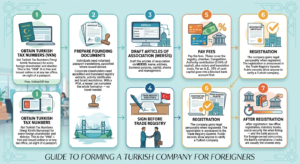
- Get Turkish tax numbers for every foreign shareholder and director. This is the “VKN” (vergi kimlik numarası). It is free and issued online or at any tax office, on sight of a passport.
- Prepare the founding documents. Individuals need notarised passport translations, apostilled where issued abroad. Corporate shareholders need apostilled and translated registry extracts, activity certificates and board resolutions. With a power of attorney, a lawyer can complete the whole formation — no travel needed.
- Draft the articles of association on MERSİS: name, address, business purpose, capital, shares and management.
- Sign before the Trade Registry directorate, in person or through the attorney. Directors’ signature declarations are issued at this stage.
- Pay the fees. These cover the registry, the chamber, the Competition Authority contribution (0.04% of capital), plus notary and translation costs. For an A.Ş., 25% of the cash capital goes into a blocked bank account first.
- Registration. The company gains legal personality when registered. The registration is announced in the Trade Registry Gazette. Those public records are also how anyone can verify a Turkish company.
- After registration: tax office registration, statutory books, a social security file when hiring — and the bank account. For foreign-owned companies, the bank’s compliance checks are usually the slowest step of all.
With complete documents, registration takes a few business days. Costs are modest. Beyond the capital — which stays the company’s own money — expect roughly USD 2,500–5,000 for a standard limited company. The exact figure depends on how many foreign documents need translation and notarisation.
Does a Company Give You the Right to Live and Work in Turkey?
This is the most misunderstood part of the subject. The rule is simple: owning shares needs no permit — working in your own company does.
- A foreigner can hold shares without any permit. Sitting as a non-executive board member of an A.Ş. is also permit-free.
- Actively managing the company is different. A managing director of a Ltd, or a managing board member of an A.Ş., needs a work permit under Law No. 6735. The company files the application. In practice, the Ministry wants substance: real paid-in capital and turnover, and as a rule of thumb five Turkish employees per foreign worker, with a grace period for new companies. The foreign partner is also expected to hold a substantial share.
- The work permit counts as a residence permit too. A working director needs no separate ikamet. A passive shareholder can apply for a short-term residence permit on other grounds.
- The exceptional permit categories of Article 16 relax these criteria. They include qualified investors — and foreign spouses of Turkish citizens (Art. 16/1-g), as covered above.
Taxes: What Will Your Turkish Company Pay?
The headline figures for 2026 are:
- Corporate income tax: 25% of net profit. Banks and financial institutions pay 30%.
- Dividend withholding: 15% on profits paid out to individuals or non-residents. A tax treaty may reduce this. Profits kept in the company bear no withholding.
- VAT (KDV): the standard rate is 20%. Reduced rates of 10% and 1% apply to listed goods and services.
- Payroll: wage tax and social security apply to employees — including a foreign director on the payroll.
What about you personally — do foreigners pay income tax in Turkey? It depends on residence. If you are tax-resident (settled in Turkey, or present more than six months in a year), Turkey taxes your worldwide income at 15–40%. If you are a non-resident, Turkey taxes only your Turkish-source income — say, your salary or dividends from the company.
Turkey has double taxation treaties with more than 80 countries. The treaty decides which country taxes what, and it can cut the 15% dividend withholding. Checking the treaty before you structure the company is money well spent. Inheritance is a separate topic with its own rules — relevant if you plan to hold Turkish assets long-term.
Company Formation Turkey: Key Takeaways
Company formation in Turkey is fast, cheap by international standards, and fully open to foreigners. The legal work takes days. The real decisions sit around the incorporation, not in it. Ltd or A.Ş.? Who will actually work in the company, and on which permit? How do the 25% corporate tax, the 15% dividend withholding and your tax treaty fit together? Founders who answer these questions before signing the articles save themselves expensive restructuring later.
Our team advises foreign founders at every stage — company formation and structuring, shareholders’ agreements, work and residence permits, tax planning and ongoing compliance. Contact us for a consultation.
FREQUENTLY ASKED QUESTIONS
For a standard limited company, out-of-pocket costs run about USD 2,500–5,000. That covers notary, sworn translations, registry and chamber fees, and professional fees. The minimum capital (TRY 50,000 for a Ltd; TRY 250,000 for an A.Ş.) is separate — it stays the company’s own asset, and a Ltd need not pay it at incorporation.
Yes. Foreigners may own 100% of a Turkish company, with no local partner. Owning requires no permit. Working in the company does.
Foreign individuals: passport with notarised translation, a Turkish tax number, photos, and a power of attorney if a lawyer runs the process. Foreign corporate shareholders: apostilled and translated registry extract, activity certificate and board resolution. The articles are drafted on MERSİS and signed before the Trade Registry.
The Turkish LLC is the limited şirket (Ltd. Şti.): TRY 50,000 minimum capital, one or more shareholders, and one or more directors. Liability is limited to capital — except unpaid taxes and social security, for which shareholders answer pro rata. It is opened through MERSİS and the Trade Registry, within days.
Corporate tax is 25% for 2026 (30% for financial institutions). Distributed dividends bear 15% withholding. Standard VAT is 20%. Payroll taxes apply to staff.
Tax residents pay on worldwide income, at 15–40%. Non-residents pay only on Turkish-source income. Tax treaties with 80+ countries prevent double taxation.
The vergi kimlik numarası — the Turkish tax ID number. Every foreign shareholder and director needs one. It is free, issued online or at any tax office on sight of a passport, and used for banks and utilities too.
The Trade Registry (Ticaret Sicili), run through the chambers of commerce on MERSİS. Registrations and changes appear in the Trade Registry Gazette, which is publicly searchable — the standard way to check that a company exists, who represents it, and its capital.
Yes, through a sole proprietorship — but you need an independent work permit under Article 13 of Law No. 6735, and these are granted selectively. Foreign spouses of Turkish citizens living in marital union benefit from the exceptional route of Article 16/1-g, which makes this path far more accessible.
Company formation alone does not confer citizenship. The investment programme requires, among the options: USD 500,000 in fixed capital or a bank deposit, USD 400,000 in real estate, or jobs for at least 50 people. Each option carries official confirmation and holding periods. A modest trading company does not qualify by itself.
Related service: A newly formed Turkish company often cannot sponsor a foreign employee until it meets the Ministry’s capital and employment conditions. If you are incorporating in order to employ yourself or foreign staff, the sequencing matters — work permits for foreign employees and their employers.