
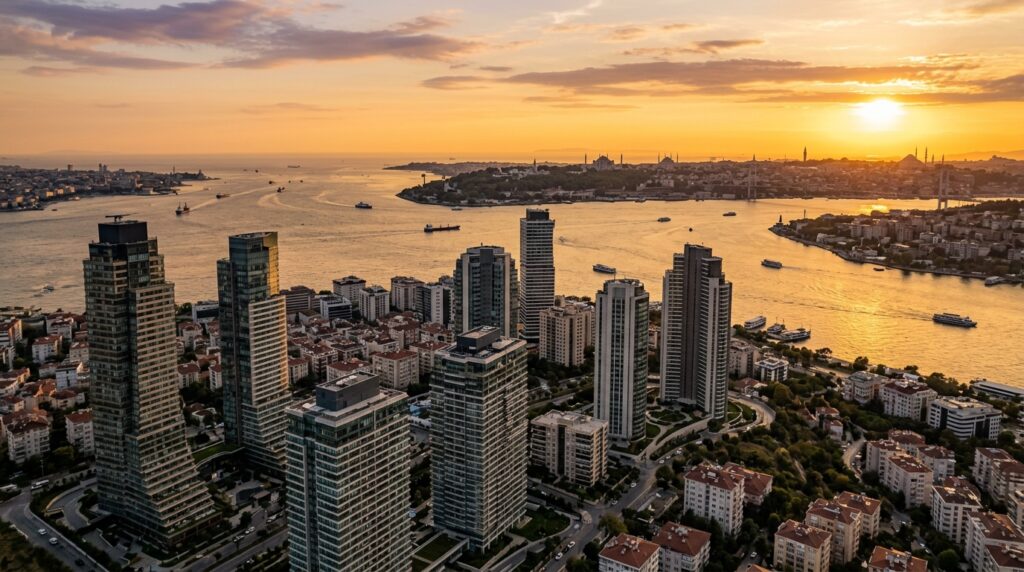
Turkish citizenship by investment lets a foreign investor, together with their spouse and children under 18, become Turkish citizens without any residence period or language test. The legal basis is Article 12/1-b of Turkish Citizenship Law No. 5901, and the final decision is made by the President.
- Real estate route: at least USD 400,000, with a three-year no-sale note on the title deed.
- Other routes: at least USD 500,000 in a bank deposit, government bonds, fixed capital, fund shares or a private pension, held for three years.
- Employing at least 50 people also qualifies, with no money threshold.
- Your spouse and children who are under 18 on the application date can be included in the same file.
- Once the file is complete, the citizenship application usually takes 90 to 180 days in our practice.
How Turkish Citizenship by Investment Works
The investment route is a two-stage process. First, the state checks your investment and issues a certificate of conformity (uygunluk belgesi). Only then does the citizenship file itself open.
This order matters. If the investment does not meet the rules, the citizenship application never starts. Most refused or delayed files fail at the investment stage, not at the citizenship stage.
Meeting the rules does not give an absolute right to citizenship. Under Article 10 of Law No. 5901, every file still passes a national security and public order review.
Investment Options and Minimum Amounts
The qualifying investments are listed in Article 20 of the Regulation on the Implementation of the Turkish Citizenship Law. Each one is confirmed by a different public authority.
| Investment | Minimum amount | Holding period |
|---|---|---|
| Real estate | USD 400,000 | 3 years (no-sale note on title deed) |
| Bank deposit in a Turkish bank | USD 500,000 | 3 years |
| Government bonds | USD 500,000 | 3 years |
| Fixed capital investment | USD 500,000 | Confirmed by the Ministry of Industry and Technology |
| Real estate or venture capital fund shares | USD 500,000 | 3 years |
| Private pension system | USD 500,000 | 3 years |
| Job creation | No money threshold | At least 50 employees, confirmed by the Ministry of Labour |
Amounts can also be met in an equivalent foreign currency or in Turkish lira. Investment floors are set by Presidential decision and have changed several times, so confirm the current figures before you send funds.
The Real Estate Route Step by Step
Real estate is the route most investors choose. It also has the most technical steps.
- Get a Turkish tax number and open a bank account. Both are needed before any payment.
- Order a valuation report. A licensed appraiser must value the property at USD 400,000 or more. The valuation, not the price on the contract, decides whether the property qualifies.
- Pay through a Turkish bank in foreign currency. The bank converts the funds and issues a currency exchange certificate. This is a strict condition: the purpose of the programme is to bring foreign currency into Türkiye, even when the purchase is financed by a loan. Keep the certificate, because the file is checked against it.
- Transfer the title deed. The land registry adds a note that the property cannot be sold for three years.
- Apply for the certificate of conformity. The land registry forwards the file to the Ministry of Environment, Urbanisation and Climate Change, which confirms the investment.
- Get an investor residence permit. Under Article 31/1-j of Law No. 6458, the investment gives you a short-term residence permit while the citizenship file is processed. The permit must actually be used: family members must use it within 180 days, and other short-term permit holders within 120 days.
- File the citizenship application. The file goes to the provincial civil registry directorate, then to the Ministry of Interior.
- Receive the decision, ID card and passport. After the Presidential decision, you are entered in the civil registry and can apply for a Turkish ID card and passport.
Check the property itself before you pay. You buy the property as a foreigner, so the foreign-buyer rules still apply: property in military or security zones cannot be sold to you. Unauthorised construction, a missing occupancy permit or land in a protected zone can make a property unusable for citizenship. Our guide on buying property in Turkey as a foreigner covers the title checks.
Routes Without Real Estate
The bank deposit, bond, fund and pension routes follow the same logic. The relevant authority confirms the investment and issues the certificate of conformity, and the funds must stay in place for three years. These routes suit investors who want a liquid asset rather than a property.
Is There a Turkish Golden Visa?
Turkey has no separate programme officially called a “golden visa”. When people search for a Turkish golden visa, they usually mean citizenship by investment.
The difference with residence matters. A property below the citizenship threshold can support a short-term residence permit, but it does not lead to citizenship. Only the investments in the table above open the citizenship route.
Who Can Be Included in the Application
Your spouse and your children under 18 can be included in the same file. The child must be under 18 on the date of application. In practice, some civil registry offices return the file of a child who has turned 18 by the time the application is filed, so do not leave it until close to the 18th birthday.
Adult children and parents cannot join through you. They need their own route, usually residence.
Turkey allows dual citizenship under Article 44 of Law No. 5901, so you do not have to give up your current nationality under Turkish law. Whether your home country allows it is a question for its own law.
Documents You Will Need
- Valid passport, with a sworn Turkish translation.
- Birth certificate and, if married, marriage certificate, apostilled and translated.
- Biometric photographs.
- The certificate of conformity for your investment.
- Your investor residence permit.
- Receipt for the state application fee.
Foreign documents need an apostille and a sworn Turkish translation. Getting them from your home country often takes longer than the Turkish side of the process.
How Long the Process Takes
The law sets no deadline. In our practice, once the file is complete, the citizenship application usually takes 90 to 180 days. The investment stage before it moves faster when the valuation, payment records and title deed match exactly.
Missing or inconsistent documents are the main cause of delay. A bank receipt that does not match the sale contract is one of the most common problems we see.
Costs of Turkish Citizenship by Investment
On top of the investment itself, each person in the file pays state fees for citizenship, residence and the passport. The 2026 amounts are below.
State Fees per Person (2026)
| Fee | Amount |
|---|---|
| Citizenship service fee (Article 12 applications, including investment) | 135.45 TL |
| Residence permit card fee | 964 TL |
| Residence permit fee, 1 year | Depends on nationality (see the next table) |
| Single-entry visa fee (once only, see below) | 9,376.40 TL |
| Passport fee, 1 year | 4,328.70 TL |
| Passport fee, 2 years | 7,066.80 TL |
| Passport fee, 3 years | 10,039.20 TL |
| Passport fee, more than 3 years | 14,147.70 TL |
| Passport booklet fee | 1,351 TL |
| Children under 25 | No passport fee; only the booklet fee applies |
The single-entry visa fee is charged only once. It applies to foreigners who entered Türkiye under a visa exemption, or who paid no fee when they obtained their visa, and then apply for a residence permit. If you already paid a visa fee, you do not pay it again.
One-Year Residence Permit Fee by Nationality (2026)
| 1-year residence fee | Nationalities |
|---|---|
| USD 80 (standard rate) | All nationalities not listed below, including the United States, the United Kingdom, Germany, Iran, Azerbaijan and Kazakhstan |
| USD 52.50 | Albania, Cambodia, Israel, Japan, Mali, North Macedonia, Oman, Philippines, Tajikistan |
| USD 36.50 | Algeria, Belarus, Belgium, Jordan, Kuwait, Luxembourg, Malta, Singapore, Spain, Taiwan |
| USD 23.50 | Ethiopia, Hong Kong, Micronesia, Russia, South Korea |
| USD 10.50 | Egypt, Iraq, Ivory Coast, Montenegro, Morocco, Tunisia |
| 27,915.20 TL | Fiji, Northern Mariana Islands, Norway, Serbia |
| Exempt (card fee only) | Czechia, Denmark, Ireland, Kosovo, Nepal, Palestine, Sri Lanka, Syria, Turkmenistan, Turkish Republic of Northern Cyprus |
USD amounts are paid in Turkish lira at the exchange rate on the payment date, and the 964 TL card fee is added for every nationality. The amount shown in your e-İkamet payment assessment is the final figure.
For example, an investor from a standard-rate country who takes a passport valid for more than three years pays about 25,975 TL plus USD 80 in state fees, if the single-entry visa fee applies.
Property Purchase Costs (2026)
| Cost | Amount |
|---|---|
| Title deed fee | 4% of the declared value. The law splits it 2% buyer and 2% seller, but in practice the buyer usually pays both shares. |
| Land registry revolving fund fee (foreign buyers) | 20,870 TL |
| Valuation report | 17,622 TL for homes and offices up to 250 m², up to 55,569 TL for larger properties; 22,479 TL to 42,120 TL for land |
| Compulsory earthquake insurance (DASK) | 879 TL to 3,395 TL per 100 m² of reinforced concrete building |
| VAT on new builds | Building permit on or after 1 April 2022: 10% on the first 150 m², 20% above. Urban transformation projects (Law No. 6306): 1% on the first 150 m², 20% above. Permit before 1 April 2022: 1% or 20% below 150 m² depending on location and land value, 20% above. No VAT on a resale between private individuals. |
| Estate agent fee | Usually 3% |
| Sworn interpreter at the land registry | 2,500 TL to 4,500 TL |
| 3-year no-sale note on the title deed | Free |
| Annual property tax (after purchase) | 0.1% of the property value per year for homes |
Costs of Bringing the Money In (Cost of Doing Business)
These are charged by the banks involved in the transfer. They are not fees paid to your lawyer or any other service provider.
| Cost | Amount |
|---|---|
| International transfer (SWIFT) charges | USD 150 to USD 2,000, depending on the sending and intermediary banks |
| Bank exchange spread when converting to lira | 0.3% to 0.5% |
| Currency exchange certificate | Free |
| Tax on converting foreign currency to lira | None. A 0.2% tax applies only if you later buy foreign currency again with that lira. |
Other Costs
- Power of attorney at a Turkish notary, with translation: about 1,750 TL to 3,500 TL.
- Sworn translation of foreign documents: about 600 TL per page. Apostilles are obtained in your home country.
- Health insurance for the residence permit: about 1,100 TL to 4,500 TL per person per year, depending on age.
- Turkish ID card: 220 TL per person.
- Legal fees, which depend on the route and the complexity of the file. We give a fixed quote before any work starts.
The calculator at the top of this page adds these items up for your property and family size.
If Your Application Is Refused
A refusal is an administrative decision. You can file an annulment action (iptal davası) with the administrative court within 60 days of the date the decision is served on you.
Under Article 31 of Law No. 5901, citizenship obtained through false statements or hidden facts can be cancelled. Accurate documents protect you after the grant, not only before it.
Other Ways to Get Turkish Citizenship
Investment is the fastest route, but not the only one. Marriage, descent and five years of residence each have their own rules. Our guide on how to get Turkish citizenship compares all five routes. After citizenship, our guide on getting your Turkish passport explains the last step.
Start Your Turkish Citizenship by Investment File
At E-Law Turkey we check the property or investment before you pay, prepare the conformity file, and follow the citizenship application to the end. Contact our Turkish citizenship by investment lawyers to confirm your route before you send funds.
This guide reflects Law No. 5901, its Implementation Regulation and published state practice as of 2026. It is general information, not legal advice for your own case.
Frequently Asked Questions
How much do I need to invest in Turkey to get citizenship?
At least USD 400,000 in real estate, or USD 500,000 in a bank deposit, government bonds, fixed capital, fund shares or a private pension. Employing at least 50 people also qualifies.
How long does Turkish citizenship by investment take?
In our practice, the citizenship application usually takes 90 to 180 days once the file is complete. The law sets no fixed deadline.
Do I need to live in Turkey or speak Turkish?
No. The investment route has no residence requirement and no language test.
Can I sell the property after getting citizenship?
Not during the three-year period noted on the title deed. After that period ends, you can sell it.
Related service: The part that fails is the property, not the application form: unauthorised construction, an occupancy permit that was never issued, or land inside a forest or heritage zone. We run due diligence on the property before the purchase, not after the refusal — property due diligence for investment applications.